
How do you ensure the purchase is legally safe?
Buying a property in Spain involves much more than just the purchase price and the completion.
Legal checks and documentation are essential to avoid problems and gain certainty about your ownership. This includes due diligence by a lawyer, applying for a NIE, and the official registration of the property.
With the right guidance, this process is both safe and straightforward.
Do I need a lawyer when buying?
A lawyer is not mandatory in Spain, but strongly recommended. They prevent legal risks and ensure the purchase proceeds safely. By carrying out due diligence, they verify that the property is legally sound and free of any hidden problems.
- Property title: Verification of ownership and any outstanding debts on the property.
- Permits: Verification of building permits and zoning regulations.
- Risks: Investigation into any pending lawsuits or outstanding claims.
- Contracts: Review of purchase agreements and additional clauses.
- Completion: Guidance with the notary, payment processing, and the handover of keys.
What is a NIE number and how do I apply for one?
The Número de Identificación de Extranjero (NIE) is the official identification number for foreigners in Spain. In practice, the NIE number is required prior to signing the title deed at the notary, and it is mandatory for property registration, opening or maintaining a bank account, and arranging utility connections. The application can be processed through the Spanish police, via a consulate, or — much more practically — handled directly by your lawyer.
Key documents required for the purchase include:
- NIE number: Mandatory for property registration, mortgages, banking, and utilities (can be requested via the police, a consulate, or handled by your lawyer; sometimes a passport is sufficient for the initial account opening).
- Identification: Valid passport or ID card.
- Purchase documents: Purchase agreement and the notarial deed (escritura pública).
- Additional items: Documentation requested by the notary or lawyer.
- Translations: Official translations and legalizations where required.
Is an energy performance certificate mandatory?
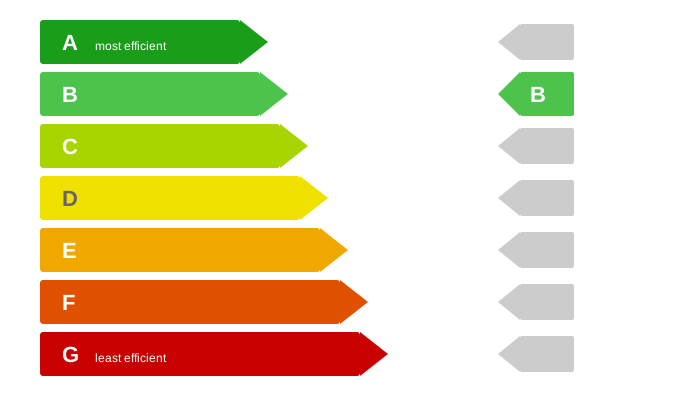
The Certificado de Eficiencia Energética (CEE) assesses the energy performance of a property on a scale from A (highly efficient) to G (least efficient). This certificate is mandatory for every sale and rental in Spain — the seller or the listing agent is responsible for providing it. In advertisements, you will often see the status en trámite (in progress); while this is permitted during the marketing phase, the final, registered certificate must be presented at the time of completion before the notary.
Key considerations:
- Mandatory for sales and rentals: The certificate must be presented to the buyer or tenant and included in all property listings.
- Final requirement at the notary: The status en trámite is sufficient for the arras (deposit) contract, but not for the completion — the notary is generally not permitted to execute the deed without a registered certificate.
- Required for mortgages: Since August 2025, a valid certificate must be available before the property appraisal can be finalized. Without the certificate, the bank will block the financing.
- Validity: 10 years (5 years for a G rating).
- Costs: €100–€500, depending on the property size; payable by the seller.
- Processing time: A technical architect can typically arrange the certificate within a few days — the status en trámite is usually due to procrastination by the seller, rather than a bureaucratic issue.
- Future EU mandate: As of 2030, a minimum energy rating of E will be required for any sale or rental, increasing to a minimum rating of D by 2033.
- Verification: As part of the due diligence process, your lawyer or buying agent will verify that the certificate is present and valid, and can include a clause in the arras contract obligating the seller to provide it on time.
How does property registration work in Spain?
Following the signing of the title deed (escritura pública) at the notary, the property is registered in the Spanish Property Registry (Registro de la Propiedad). Only then are you officially the owner and protected by law against third-party claims. Steps for property registration:
- Notarial deed: Drafting and signing of the escritura pública.
- Property Registry: Inscription in the Registro de la Propiedad.
- Verification: Review of ownership and encumbrances by the registry.
- Protection: Legal certainty and protection against third-party claims.
- Support: Often handled by a lawyer or gestor.

How can I help with legal matters?
I’ll introduce you to an experienced lawyer who represents your interests exclusively, carries out the due diligence, assists with your NIE application, and ensures correct registration in the Registro de la Propiedad — so you have certainty about your legal ownership. Through a notarised power of attorney, matters can be handled without you being present yourself — convenient for anyone who can’t always be there in person.
Want to make sure everything is legally in order?
Buying in Spain calls for the right legal guidance — someone who knows the local legislation, checks every document, and acts exclusively in your interest. I’d be glad to introduce you to a specialised lawyer on the Costa Brava with in-depth knowledge of the Catalan property market. Feel free to get in touch by email, WhatsApp, or the button below.